Author Archives: camillebaillyleclerc

Be part of the growing CSR reporting trend!


Background story: The majority of our blog posts deals with CSR topics; we write about the latest developments in this field and try to relate it to a company’s daily business. Our background stories have a different perspective: Here, we explain trends, scientific background and societal implications of corporate sustainability – sometimes with a personal touch.

success-1093889_1920

You already have heard this acronym at work, and even came across a CSR report, and you will hear even more. Indeed, CSR reporting is growing.

CSR reporting is a communication tool on dedicated topics.

You may wonder: what is CSR reporting? There are different scientific and accepted definitions. Our definition is: any documentation related to the company’s management and performance regarding social and environmental topics that is disclosed publicly, and which aims at informing the stakeholders of how the companies manage the impacts towards them.

A stakeholder is said to be any party affected by the organization’s operations: shareholders, customers, suppliers, employees, local communities, civil society, industry, government… CSR reporting is then a tool to communicate the organization’s efforts to the impacted stakeholders.

We identified some of the main CSR reporting schemes

To bring more value to your reporting, you can use reporting standards and schemes. Although there are many CSR schemes, standards, ratings, we chose to focus on the ones which are leading in terms of influence and companies participating and which are not-for-profit organizations. The following list is then not exhaustive.

Regarding environmental reporting, you can choose to answer the CDP questionnaire, on water, climate change, or forest management. CDP[1] (Carbon Disclosure Project) is an NGOs collecting environmental data to ensure transparency to decision-makers like investors or clients.

To structure your CSR report, you can opt for two options: use the framework suggested by the United Global Compact, or use the GRI (Global Reporting Initiative) Guidelines.

When you adhere to the UNGC 10 principles[2], you have then to report your progress on a Communication On Progress. This can be a good idea for beginners, as this communication offers a structure which is not too much stringent.

Read our article for a full overview: https://blog.dfge.de/2015/01/29/un-global-compact-dfge-publishes-2015-cop-report/

For more experienced reporters we will suggest to use GRI Guidelines[3], where companies can identify the topics which are the most relevant for them and their stakeholders, and then report specific indicators accordingly (see our blog article for more information: https://blog.dfge.de/2015/11/25/understand-gri-in-2-minutes/).

CSR reporting has grown steadily over the past fifteen years

Over the past decade, CSR reporting has become mainstream. The figures show that the use of internationally recognized standards and schemes is steadily growing. This can be explained by the fact that these initiatives are multi-stakeholder, hence they are more objective than a stand-alone reporting. They also provide guidance and structure which can help the company identify gaps to improve on some areas.
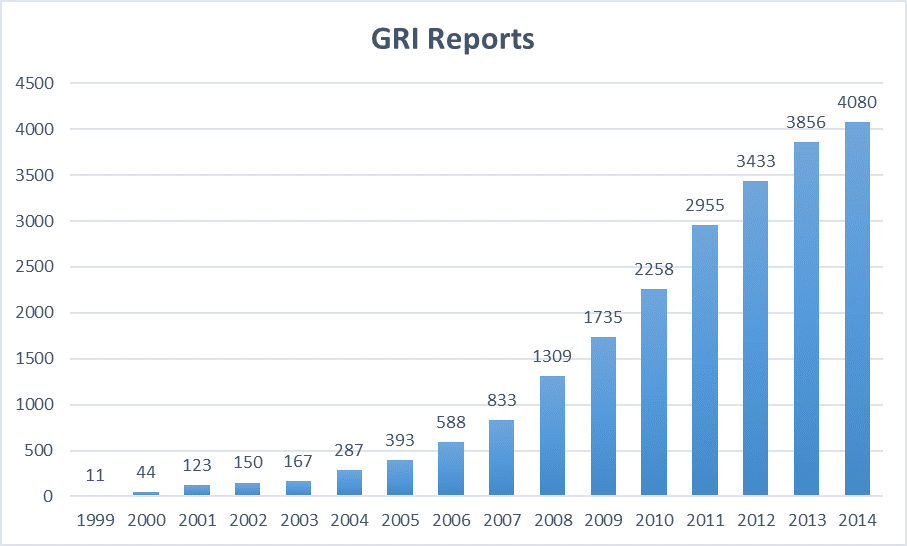
GRI trends

(data extracted from the search function of GRI database, http://database.globalreporting.org/search)
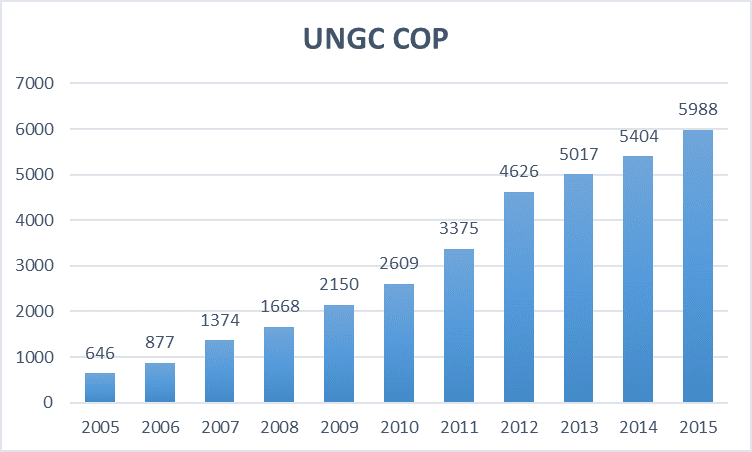
UNGC trends

(data extracted from UNGC infographic Communication on progress, 2015 key facts,https://www.unglobalcompact.org/docs/communication_on_progress/cop-key-facts-2015.pdf)

CDP, in its 2015 activity report, indicates that they analyzed 1799 responses in 2010 against 1997 in 2015, showing also a growing participation. The number of signatories has also been increasing.CDP trends
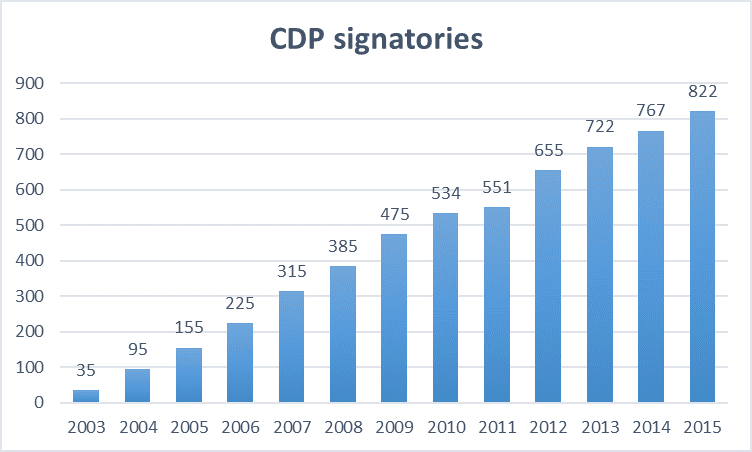
(data extracted from CDP Global Climate Change Report 2015, https://www.cdp.net/CDPResults/CDP-global-climate-change-report-2015.pdf )

It means that companies have an advantage to report through these schemes: they are of interest for investors, clients, and other stakeholders.

What are the next trends in CSR reporting?

We believe that reporting will increasingly focus on sectorial-specific issues. Indeed, now that the general framework is somehow set and recognized by organizations, some more specific information can be added.

For instance, the Telecommunications sector is faced with the problematic of conflict minerals. Electronics companies now report on how they implement due diligence process in their supply chain and declare if they are conflict-free for the following materials: gold, tin, tantalum, tungsten. A dedicated guidance is provided by the CFSI (Conflict Free Sourcing Initiatives).[4]

We also think that more and more SMEs will report their CSR progress – as bigger companies will increase their pressure on suppliers to take the next step and report along the whole supply chain.

DFGE can guide you through your reporting process. Don’t hesitate to contact us for more information at info@dfge.de or consult our website.


[1]CDP: https://www.cdp.net/en-US/Pages/HomePage.aspx

[2] UNGC: https://www.unglobalcompact.org

[3] GRI: https://www.globalreporting.org/standards/g4/Pages/default.aspx

[4] CFSI: http://www.conflictfreesourcing.org/conflict-minerals-reporting-template/http://www.conflictfreesourcing.org/conflict-minerals-reporting-template/http://www.conflictfreesourcing.org/

image link: https://pixabay.com/en/success-curve-hand-finger-touch-1093889/

CDP Climate Change – revised questionnaire for 2016 and new scoring methodology


P1050417

The CDP (Carbon Disclosure Project) has updated its methodology for the year 2016 regarding the CDP Climate Change questionnaire.

What is CDP?

Through CDP, around 6,000 organizations disclose their greenhouse gases emissions and other environmental KPIs, on the request of the shareholders or their clients. Through measurement, organizations are expected to better manage climate change mitigation.

What are the main changes?

  • Change in Climate Change scoring methodology. There will no longer be a disclosure score and a performance band, but one score, which will be located on a four-band scale: leadership (A), management (B), awareness (C), disclosure (D), like already introduced for the CDP water program in 2015. Answers to the CDP questions may be eligible to points in the four scoring categories disclosure, awareness, management, leadership. At least 75% of points must be scored on a certain scoring level in order to advance to the next higher lever.
  • Alignment with GHG protocol for Scope 2 emissions. Organizations now need to explain if the figures are market-based or location-based. Location-based means that the calculation is based on a figure reflecting the geographical electrical grid. For market-based, this figure reflects the emissions of the product, or the supplier. As figures need to be comparable, organizations need to select one of the option and convert the figures from the 2015 report or figures for the new 2016 report accordingly
  • Renewable energy. Organizations have now the possibility to report their renewable energy production and consumption, as well as any renewable energy targets.
  • Science-based targets. Company now need to specify whether their reduction target is science-based, meaning in alignment with climate science recommendations and scenarios, to keep global warming below 2°C.
  • Management fee: Companies from North America and Western Europe responding in the CDP Investor Program will be charged a management fee to contribute to the funding of the CDP project. The basic fee is set at 2.475 EUR, with the option to make a higher contribution, or to choose a subsidized, lower fee. First-time responders, as well as companies responding to their customers via the Supply Chain Program do not need to pay a fee.

For more information, please consult:

Changes & Rationale Document: https://www.cdp.net/Documents/Guidance/2016/CDP-Climate-Change-changes-document-2016.pdf

CDP 2016 Climate Change scoring methodology Introduction:  https://www.cdp.net/Documents/Guidance/2016/CDP-climate-change-scoring-methodology-2016.pdf

Scoring introduction 2016: https://www.cdp.net/Documents/Guidance/2016/Scoring-Introduction-2016.pdf

Accounting of scope 2 emissions: https://www.cdp.net/Documents/Guidance/2016/CDP-technical-note-Accounting-of-Scope-2-Emissions-2016.pdf

As a CDP official partner, the DFGE is happy to provide more details on these changes and help your organization adapt to them. With our in-depth CDP Response Review, you can make sure you cover all requirements from the new questionnaire and scoring methodology. Please contact us at info@dfge.de or +49.8192.99733-20


Freely chosen employment: a focus of EICC Code of Conduct latest version


Background story: The majority of our blog posts deals with CSR topics; we write about the latest developments in this field and try to relate it to a company’s daily business. Our background stories have a different perspective: Here, we explain trends, scientific background and societal implications of corporate sustainability – sometimes with a personal touch.

document-428334_1920


The EICC Code of Conduct – 5.1 version was released in January 2016 to include stringent requirements on the fight against forced and bonded labor.

A sectorial initiative to tackle CSR issues

The EICC is a nonprofit coalition of electronics companies comprised of more than 100 electronics companies with combined annual revenue of over $3 trillion, directly employing more than 5.5 million people. The companies are committed to supporting the rights and wellbeing of workers and communities worldwide affected by the global electronics supply chain.[1]

To do so, a Code of Conduct was set up, and the coalition provides training and assessment tools regarding environmental, social and ethical responsibilities.

The Code of Conduct was launched in 2004, and has been adapted and changed to match the evolution of these themes. The version 5.1 has been released on the 1st of January 2016 and will come into force from the 1st of April 2016.

Change in freely chosen employment section

The only change from version 5.0 released in November 2014 to the version 5.1 of January 2016 focuses on freely chosen employment (section A,1).

The version 5.0 states that “workers shall not be required to pay employers or agents recruitment fees or other aggregate fees in excess of one month’s salary. All fees charged to workers must be disclosed and fees in excess of one month’s salary must be returned to the worker.”, whereas the 2016 version reads that “workers shall not be required to pay employers’ or agents’ recruitment fees or other related fees for their employment. If any such fees are found to have been paid by workers, such fees shall be repaid to the worker.”

This means that the requirements are strengthening. Before, there was a limit which is no longer tolerated. Our understanding is that a common practice of forced labor is indeed that employees have to pay a fee to be employed, either to the employer or to a recruiting agent. However, they usually cannot afford it right away, so they remain in debt to the employer or recruiting agent, so they have to keep working in the company at least to be able to pay this employment fee.

This more stringent requirement can be explained in a larger context where forced labor is still existing. For instance, the NGO Verité’s two-year study of labor conditions in electronics manufacturing in Malaysia found that “one in three foreign workers surveyed in Malaysian electronics was in a condition of forced labor.”[2]

Tackling forced labor issues

There are different ways to tackle this existing issue:

  • Risk-mapping to identify where cases are most likely to happen
  • Action plans accordingly
  • Actions can feature:
    • Specific HR procedures preventing unreasonable restrictions on entering or existing the facilities, forbidding employment fees, prohibiting the confiscation of immigrant documents
    • Training of HR population in this sense
    • Whistle blowing system to detect and treat such cases
    • Audits to check the status of such actions

For more information, please contact us at info@dfge.de or read the EICC Code of conduct: http://www.eiccoalition.org/media/docs/EICCCodeofConduct5_1_English.pdf

[1] http://www.eiccoalition.org/about/

[2] http://www.verite.org/research/electronicsmalaysia

image source: https://pixabay.com/en/document-agreement-documents-sign-428334/

SDGs: a topic of interest for companies


IMGP3116

On the 17th of February, DFGE co-animated a webinar on Sustainable Development Goals with the World Environment Center. For those who missed it, we summarize the main conclusions of the webinar in this article.

The webinar featured sustainability experts.

Elisa Tonda (Head of Business and Industry Unit, UNEP), Lorraine Francourt (Director, EH&S & Sustainability, EMEA & AP, The Dow Chemical Company), Wolfgang Berger (VP Business Development, DFGE- Institute for Energy, Ecology and Economy) and Terry F. Yosie (President and CEO, World Environment Center) presented current trends on how companies are using the Sustainable Development Goals and on how companies can address them.

Main highlights from the webinar

(1) The SDGs are becoming important because they provide an internationally approved framework to address global challenges. Business has a vital interest in a world free from human suffering and environmental degradation and finds it essential that coordinated and measurable action takes place.

(2) Companies find value in using the SDG’s, e.g. because they help identify and meet societal expectations, especially in developing markets where the major growth opportunities lie.

(3) Companies such as Dow Chemical are already applying the SDGs. They have gone through intense stakeholder consultations (both internally and externally) and have now embedded their sustainability goal-setting-process into a structure that allows for measuring and reporting on the SDGs. Dow sets goals for each of the SDG’s but not for each indicator. Even less ambitious companies that address just a few goals would be coherent with the United Nation’s objective: every company should find its own way of contributing to the SDGs.

(4) Companies can align the SDGs with their business strategies and existing reporting frameworks such as Global Reporting Initiative (GRI), UN Global Compact, and CDP responses. While the SDGs may have similar content to the aforementioned, these pre-existing initiatives and frameworks are generally more focused in certain areas. The SDGs are, instead, a framework to report on a company’s contribution to solve global challenges and enable a strategic perspective for companies that actively want to identify business opportunities for the common good.

A worldwide topic

It seems that companies show a deep interest in this topic. Slightly more than 100 sustainability experts attended the webinar. 74% were business representatives, while 26% were from academia, advisory firms, governments, and NGO’s. Geographical distribution was 49% from Europe, 38% from the US, 8% from Latin America and 5% from Northern Africa/Middle East/Pacific.

For more information, please consult: https://sustainabledevelopment.un.org/sdgs or our blog article on how to address SDGs: Companies are key to the success of the Sustainable Development Goals. You can also directly consult us at info@dfge.de

EcoVadis Partnerschaft mit DFGE: Neuer Schwung für nachhaltige Beschaffung in der DACH-Region


ecovadis-logo01

DFGE wird der erste Consulting Partner in der DACH-Region von EcoVadis, dem Experten für Nachhaltigkeit in der Lieferkette. Diese Zusammenarbeit wird es Unternehmen künftig ermöglichen, besser auf die Anfragen ihrer Kunden bei einem EcoVadis-Assessment einzugehen und ihre CSR-Performance zu verbessern.

EcoVadis, eine kollaborative Plattform für Nachhaltigkeitsbewertung

EcoVadis betreibt die erste kollaborative Plattform, die Supplier Sustainability Ratings für globale Lieferketten bereitstellt. Über 25 000 Unternehmen nutzen das Corporate Social Responsibility (CSR)-Assessment von EcoVadis, darunter mehrere Tausend in Deutschland, Österreich und der Schweiz. Sie erhalten darüber eine Bewertung und Scorecard ihrer Leistungen in den Bereichen Umwelt, Soziales, Ethik, und Lieferkette.

EcoVadis bietet eine konkrete Lösung, die Transparenz zu CSR in der Zulieferkette schafft. Unternehmen treten der EcoVadis-Plattform bei und fordern ihre Zulieferer dazu auf, deren Nachhaltigkeits-Management von EcoVadis beurteilen zu lassen. Diese Analyse wird von EcoVadis-Experten durchgeführt; die Ergebnisse werden auf der gemeinschaftlichen Plattform in Form einer Scorecard veröffentlicht, zugänglich für sowohl Einkäufer als auch für Zuliefere.

DFGE bietet verschiedene Dienstleistungen an

DFGE ist jetzt offizieller EcoVadis Consulting-Partner, der Zulieferern dabei hilft, diese Komplexität zu verstehen und die Anforderungen zu erfüllen. EcoVadis vertraut der DFGE entsprechende Trainings und Überprüfungen der ausgefüllten Fragebögen an.

Trainings werden für das Ausfüllen des Fragebogens und den Umgang mit der Plattform angeboten. Sie zielen darauf ab, es den Zulieferern zu ermöglichen, den Fragebogen selbstständig auszufüllen und die Anfragen ihrer Kunden zu beantworten. DFGE wird auch ausgefüllte Fragebögen überprüfen, um sicherzustellen, dass die Antworten den EcoVadis-Anforderungen und der Methodik entsprechen.

Mit mehr als 15 Jahren Erfahrung im Bereich der Nachhaltigkeits-Datenverwaltung kann die DFGE Zulieferern dabei helfen, die richtige Dokumentation zu finden und zu verbessern. Die DFGE bietet auch Komplettpakete an, die dabei helfen, die eingesetzte Zeit und Ressourcen bei einer EcoVadis-Teilnahme zu minimieren.

Darüber hinaus kann die DFGE unter anderem auch dabei beraten, die erzielten Ergebnisse zu verstehen, einen Verbesserungsplan aufzustellen, das Nachhaltigkeitsmanagement durch Erstellung beispielsweise eines Carbon Footprints zu verbessern oder einen CSR-Bericht nach GRI-Richtlinien aufzustellen.

Zusammenfassend können EcoVadis-Teilnehmer also von Beratung und Unterstützung durch die DFGE profitieren, und zwar in ihrer jeweiligen Landessprache. Die DFGE wurde durch EcoVadis geschult, um die offiziellen Produkte anbieten zu können.

Die ganze Pressemeldung lesen: http://www.dfge.de/de/ecovadis-partnerschaft/

Mehr zu EcoVadis: http://www.ecovadis.com/

Oder kontaktieren Sie uns unter  info@dfge.de


Companies are key to the success of the Sustainable Development Goals


IMGP3134

DFGE recently co-animated a webinar organized by the World Environment Center on how Sustainable Development Goals (SDGs) can be implemented at corporate level. Here is the short summary of what was discussed there.

SDGs are the world’s new sustainability agenda

The Sustainable Development Goals were defined by the United Nations to set the 2030 agenda for sustainable development. They build on the Millennium Development Goals (2000-2015) to extend them. The 17 goals cover the three dimensions of sustainable development (Environment, Social, Economic) and targets have been defined to reach them. All countries and all stakeholders agreed to strive to implement them.

SDGs are a reference for organizations

The partnership between stakeholders and companies is key to ensure the achievement of the SDGs. In this sense, companies can use the SDGs as a reference to showcase how their actions impact the global picture: it is a way to ensure better transparency.

Like many other frameworks, it does not compete with existing standards, but companies can build upon them. For instance, answering to CDP will enable to tackle SDG 13 on climate action.

SDGs are also a framework where companies can understand the needs of the stakeholders like local institutions and communities. Dialogue with stakeholders enable companies to identify topics which are material for them, and to align it with the CSR strategy.

CSR management and reporting can help address the goals

CSR (Corporate Social Responsibility) is a way for companies to tackle these global challenges.

With CSR reporting, companies inform the stakeholders they previously consulted and engaged, and can show how their projects are reducing environmental, social and governance impacts.

With a CSR management system, a continuous improvement is fostered. Indeed, impacts are identified and targets are set accordingly. Then actions are implemented to reach these objectives. KPIs enable to measure the success of these actions, and a review leads to new actions.

Below you will find a list of examples of corporate actions that can be implemented.

Examples of corporate actions for each goal

  1. No poverty: labor management relations with a notice before changes, alternative solutions to lay-offs fostered through social dialogue, clear rules for remuneration
  2. Zero hunger: ensuring no poverty (SDG1) leads to less hunger. Partnerships with local community and NGOs on food topics (donation, training, volunteering,)
  3. Good health and well-being: health and safety program including stress prevention plan, ergonomics in the workplace, work-life balance measures
  4. Quality education: training plan for skills enhancement and implementation
  5. Gender equality: equal remuneration, rules for hiring, training of HR and managers on discrimination, whistle-blowing system
  6. Clean water and sanitation: water reduction project, wastewater treatment equipment
  7. Affordable and clean energy: resort to sustainable energy sources, energy reduction program
  8. Decent work and economic growth: rules for hiring, training of HR and managers on identification and prevention of child labor, forced labor, whistle-blowing system… Implementation of shared value initiatives including valorization of the value chain (for example by training a supplier, which then delivers a better product)
  9. Industry, innovation and infrastructure: participation in industry initiatives, like the EICC and the EICC code of conduct for Telecommunications sector
  10. Reduced inequalities: diversity program, non-discrimination training and whistle-blowing
  11. Sustainable cities and communities: stakeholder engagement program, shared value initiatives, community involvement program, community development program (donations, volunteering,)
  12. Responsible consumption and production: sustainable procurement program (risk-assessment, code of conduct, performance assessment, improvement actions, responsible sourcing) and promotion of sustainable consumption (eco-labels, information to customers about sourcing)
  13. Climate action: carbon footprint calculation, energy-efficient materials and measures
  14. Life below water: prevention of water pollution (waste water treatment), partnership with a dedicated NGO
  15. Life on land: natural habitats restoration, assessment of risks linked to biodiversity before construction, partnership with a dedicated NGOs
  16. Peace, justice and strong institutions: Ethics and compliance program, featuring a whistle-blowing line to report such cases, and adequate treatment
  17. Partnerships for the goals: stakeholder engagement program, partnerships on dedicated topics material for the company

If your company would like to know more about how these actions can be quickly implemented, we remain at your entire disposal at info@dfge.de. You can also visit our website: http://www.dfge.de/en/sustainability-communications/ . To know more about the goals: https://sustainabledevelopment.un.org/sdgs


EcoVadis and DFGE partnership: boosting sustainable procurement in the German-speaking region


ecovadis-logo01DFGE becomes the first Consulting Partner in the German-speaking region of EcoVadis, the leader in supply chain sustainability ratings. This partnership will help companies to better answer their clients’ requests for an EcoVadis assessment, as well as to improve CSR performance.

EcoVadis, a collaborative sustainability rating platform

EcoVadis operates the first collaborative platform providing Supplier Sustainability Ratings for global supply chains. More than 25,000 companies use EcoVadis’ Corporate Social Responsibility (CSR) assessment, including thousands in Germany, Austria and Switzerland, which provides a rating and scorecard on their environmental, social/labor, and ethical practices.

EcoVadis provides a concrete solution enabling CSR transparency in the supply chain. Companies subscribe to EcoVadis and require their suppliers to be assessed by EcoVadis on their sustainability management. This analysis is carried out by EcoVadis experts and the results are then published on a collaborative platform, accessible by both buyers and suppliers, in the shape of a scorecard.

DFGE will offer various services

EcoVadis trusts DFGE in providing trainings and pre-checks of responses. Trainings are about EcoVadis principles, the questionnaire and platform management. They aim at empowering suppliers in completing the questionnaire and responding to clients’ requests. DFGE will also provide response checks to make sure that the answers are aligned with EcoVadis requirements and methodology. With more than 15 years of experience in sustainability data management and reporting, DFGE can help suppliers to find and improve the right documentation. DFGE also offers complete service packages that reduce company’s investment in time and resources and prepare all requested information to submit to EcoVadis.

On top of that, DFGE can also provide guidance to explain the results of the scorecard, conduct an improvement plan, consolidate the sustainability management system by providing dedicated documents such as the carbon footprint, a CSR report based on GRI guidelines, among other services.

As a consequence, EcoVadis users can benefit from guidance and dedicated feedback, in their own speaking language. DFGE has been trained by EcoVadis to provide the official products.

To read the full PR: http://www.dfge.de/en/ecovadis-partnership/

To learn more about EcoVadis: http://www.ecovadis.com/ or DFGE: http://www.dfge.de/en/

Or contact us at info@dfge.de for any question or information.

We just released our sustainability report – what about you?


Endorser Logo_gradient_blue_RGB


DFGE – Institute for Energy, Ecology and Economy is happy to share its second CSR/sustainability report, which takes the shape of a Communication On Progress (COP).

What is a Communication On Progress (COP)?

In 2015, DFGE produced its first Communication On Progress, a document showing the targets, the actions implemented to reach the targets and the measurement of outcomes for four sustainability issues: Human rights, Labor Practices, Environment and Anti-corruption.

These issues are listed under the 10 United Nations Global Compact principles.

Companies who commit to the United Nations Global Compact need to issue this Communication on Progress on a yearly basis. This document can be considered as the CSR or Sustainability report of the company.


What can be the main highlights?

For each topic, companies can explain which risks they have identified and on which basis, set related targets and formalize commitments in this sense. For instance, DFGE committed to promote UNGC and CSR even more, hoping to have at least one additional partner taking part in this international initiative.

Then, organizations can describe their actions and specify their scope of application, their purpose, etc. For instance, DFGE of course assessed its own carbon footprint to identify sources of emissions that lead to take new commitments and set new targets.

Finally, a measurement of outcomes enables stakeholders to understand the progress of the organization in each domain. For example, DFGE committed in 2015 to formalize hiring processes and to implement appraisal interviews, and in 2016 it was reported that these targets were met.


What are the benefits of such submission?

As a sustainability solution provider, DFGE wants to uphold and support CSR/sustainability international standards. For any company, it is an internationally recognized tool that can help disclose information to stakeholders in an easy way. Indeed, the Communication On Progress offers flexibility as the principles can be adapted to any company according to its size, sector, location, corporate culture. It is also a tool that helps improving sustainability management thanks to the goal-setting and reviewing.

You can consult DFGE’s COP on the UN Global Compact database. Further information on our website: http://www.dfge.de/en/sustainability-communications/un-global-compact-services/ or on the UN Global Compact portal www.unglobalcompact.org.

World Economic Forum: the future is in your hands!    


23894035713_fc88747bae_z

Why is the World Economic Forum important?

The 2016 World Economic Forum annual meeting took place in Davos, Switzerland, from the 20th to the 23rd of January and gathered decision-makers from all over the world. It enables to raise awareness among the most influential people of the world: indeed, it provides an opportunity to gain momentum and concretize current projects like the Paris Agreement from COP21 or the Sustainable Development Goals.

A new era: the fourth revolution

One of the key focus was the Fourth Industrial Revolution, a concept developed by Professor Klaus Schwab, Founder and Executive Chairman of the World Economic Forum, stating that this revolution is characterized by new technologies fusing the physical, digital and biological world. Technology can thus be a way to address current challenges.

Current challenges are deeply intertwined with sustainability agendas

  • Food security. By 2050, the world must feed 9 billion people.
  • Inclusive growth. Our current social, political and economic systems are exacerbating inequalities, rather than reducing them, which can lead to anger and xenophobic attitude
  • International Labor Organization estimates that more than 61 million jobs have been lost since the start of the global economic crisis in 2008.
  • Climate change. 2015 was the Earth’s warmest year in recorded history.
  • Gender equality. The gender gap has reduced, however some efforts still need to be done, including in remuneration.
  • The number of inhabits is rise to 9.7 billion in 2050 with 2 billion aged over 60.
  • 200 million SMEs don’t have access to formal financial services.
  • Focus in long-term projects will be beneficial.

How can your company contribute?

Any organization can contribute to address these global challenges, especially

  • Climate change. Organizations can assess their carbon footprint to identify the sources of emissions, set reduction targets accordingly, and implement actions to reduce them like switching to energy-efficient equipment, fostering car-sharing and public transportation among employees, among others
  • Gender equality. To tackle gender equality, companies can issue non-discrimination rules, raise awareness among the decision-makers, and provide the same compensation and benefits on the basis of past experiences and skills, or implement a whistle-blowing system to report such cases and deal with them
  • Inclusive growth/employment. Companies play a key role in employing people. A solution for inclusive growth can be to implement shared value initiatives by launching a new product meeting social needs, or redefining productivity the value chain while focusing on the social and environmental constrains in the supply chain, or create a local competitive cluster
  • Healthcare. Companies can help foster employees’ health and well-being by focusing on ergonomics in the workplace, preventing stress, preventing occupational diseases.

If you are an organization aiming at improving sustainability and planning to participate in sustainability reporting, or looking for support when calculating your carbon footprint – contact us to learn more about our services via info@dfge.de

For more information about the forum: http://www.weforum.org/about/world-economic-forum and the world challenges: http://www.weforum.org/agenda/2016/01/what-are-the-10-biggest-global-challenges

The DFGE– Institute for Energy, Ecology and Economy provides consulting and auditing services to realize a Green Vision integrated in corporate business processes. Strategic advice on topics like technology, energy and emissions is expanded to business related and socio-economic aspects. Services range from consultancy in developing and managing customized analysis for testified Carbon footprint to validation of analysis methods and results for sustainable accuracy. As independent Institute DFGE’s work is based on advanced scientific and research methods and institutionalized standards. More at  http://www.dfge.de

Image credit: World Economic Forum, under the Creative Commons licence (BY-SA 3.0)


COP21: speeding up climate change actions


for blog

THE UNFCCC 21th Conference of Parties (COP21) was held in Paris from the 30th of November to the 12th of December, 2015. The 195 countries represented here reached an historical agreement to curb climate change.

The Paris agreement at a glance:

  • Objective to keep temperature rise below 2°C and try to limit it to 1.5°C
  • Five-year cycle of actions. 186 countries have published their action plans to reduce emissions.
  • Review mechanism every five years, with a first world review in 2023. This will help increase the transparency, countries will be required to report on their emissions.
  • Focus on climate change adaptation instead of mitigation, which means “adjusting systems in response to climate change, with changes in processes, practices, and structures to moderate potential damages or to benefit from opportunities associated with climate change,”(UNFCCC) while mitigation is about reducing GHG emissions.
  • Finance and burden-sharing. Developed countries are to provide financial resources to help resources countries, up to 100 billion dollars from 2020.
  • Loss and damage principle. The agreement acknowledges the Warsaw International Mechanism (WIM) on Loss and Damage, created in 2013 to deal with the cases when mitigation and adaptation fail.


What is next?

The agreement will be open to signature on next Earth day, the 22nd of April, 2016. To be enforced, at least 55 countries must ratify it, and they must represent at least 55% of the world’s emissions.

What can you do?

Every organization can take part in mitigating climate change and reducing emissions! A first step is to assess the carbon footprint to then reduce the identified emissions by implementing many simple actions at local level.

For more information: Paris agreement and a related infographic, UNFCCC, carbon footprint,  or contact us at info@dfge.de